The Wachau: The World-Class Wine Region Worth Knowing
Austria's most precise whites have been absent from Asian tables. That is about to change.
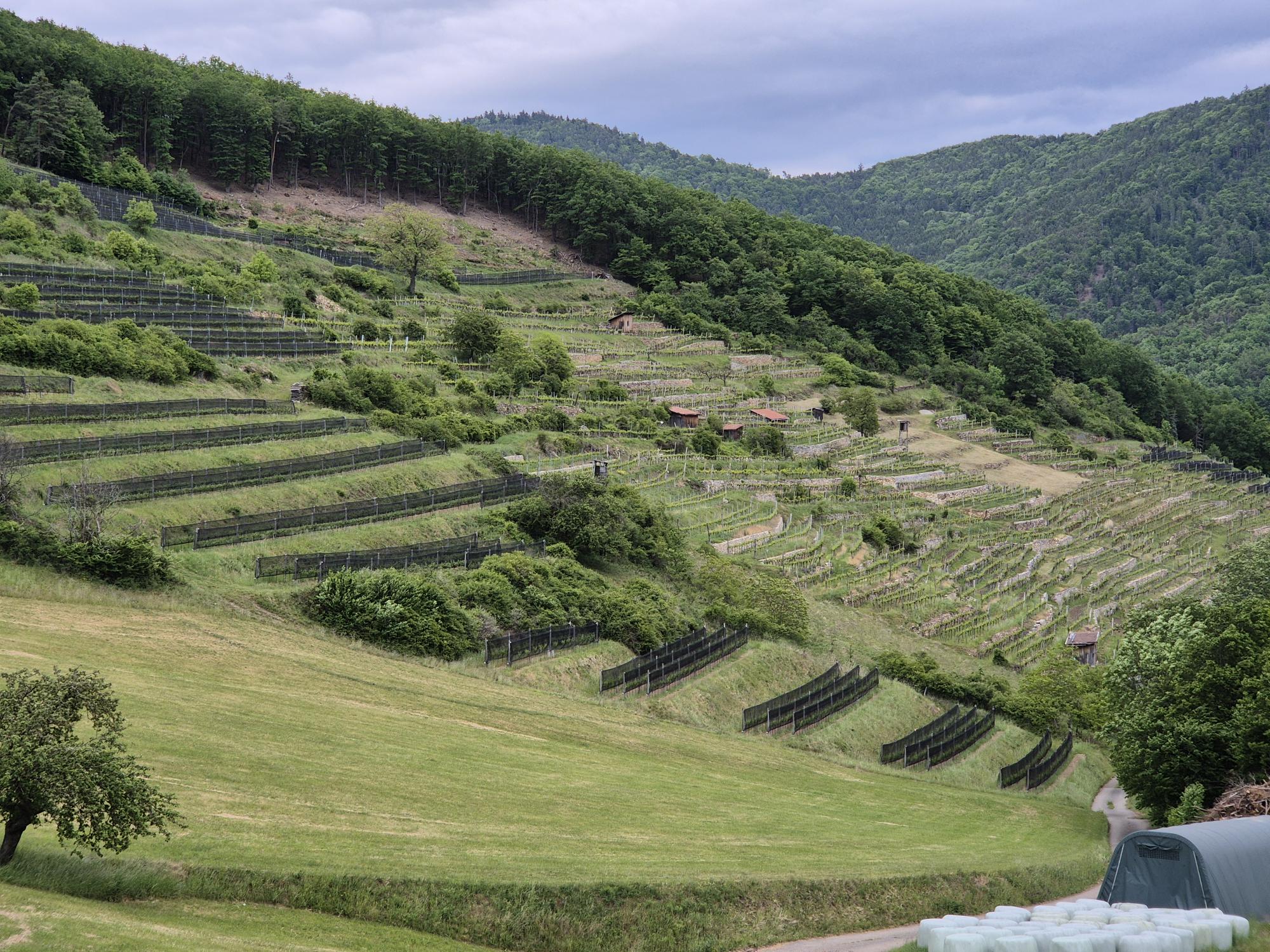
Ried Trenning, the highest vineyard in Wachau. (Photo Credit: Jackie Ang)
A visit to Vievinum, Austria's largest wine fair in Vienna, followed by producer visits across the Wachau was always on my agenda, but what I didn't expect was how many of these producers had little to no representation in Singapore, and how much that absence matters for those of us who love both great white wine and the food we grew up eating.
The Wachau produces Grüner Veltliner and Riesling of genuine world-class quality, with a structure and character that I believe sits particularly well at an Asian table, and yet these wines remain largely unknown in our market. I came back wanting to change that.
The Reputation Revival
Few wine regions have had to rebuild their reputation from as low a point as Austria did in the 1980s, when a scandal involving the addition of diethylene glycol to sweeten wines devastated the country's export market almost overnight. But the Wachau's response was swift and structural.
In 1983, a group of the region's top growers founded Vinea Wachau, a producer association that instituted one of the most rigorous quality and authenticity frameworks in European wine. Central to this was a three-tier style classification unique to the region: Steinfeder, the lightest style at under 11.5% alcohol, named for the feather grass that grows on the region's dry stone walls; Federspiel, the middle tier between 11.5 and 12.5%, named for the peregrine falcon once used by falconers in the valley; and Smaragd, the fullest and most age-worthy style above 12.5%, named for the emerald lizards that bask on the sun-warmed terraces.
These are not marketing categories, as membership of Vinea Wachau binds producers to natural winemaking, no chaptilisation, and verifiable origin. The region's recognition as a UNESCO World Heritage Site in 2000 confirmed what the growers had already built from the ground up: a place where the label tells you almost exactly what is in the glass before you have poured it.
The Wachau also operates a parallel origin-based classification that will be familiar to anyone who knows Burgundy or Rioja: regional wines, village wines, and at the top, Riedenwein, the single vineyard tier. Only Grüner Veltliner and Riesling are permitted at this highest level, a reflection of how completely this region has organised itself around two varieties. They account for 78% of total production across 1,350 hectares, of which 97% is planted to white varieties. The focus is deliberate and it shows in the wines.
The two varieties also tend to occupy different parts of the landscape. Grüner Veltliner gravitates toward lower altitudes and gentler loess soils, producing wines that are broader and more textural. Riesling climbs higher, onto the steeper slopes of schist and gneiss, where the poorer soils and cooler temperatures produce the variety's characteristic tension and aromatic precision. Understanding this division is a useful key to reading the region before you have tasted a single wine.
Before going further into the single vineyards, it is worth pausing on the Federspiel tier. It is easy to assume that Smaragd, as the fullest and most age-worthy style, is where all the serious wine lives. That would be a mistake. On this trip I encountered Federspiel wines of genuine elegance and precision, particularly Weingut Knoll's Riesling Ried Loibenberg and Weingut Franz Hirtzberger's Grüner Veltliner Rotes Tor, both of which had the tension and freshness to be among the most food-friendly wines I tasted across the entire region. The Federspiel Grüner Veltliner in particular is a natural partner for white fish sashimi, where the wine's clean acidity and gentle weight don't overwhelm the delicacy of the fish. Dishes built around lemongrass or mint find something similar in the variety's characteristic white pepper note, a pairing that feels almost designed even when it wasn't.
Achleiten
Located in Weißenkirchen in the central Wachau, directly above the northern bank of the Danube, Ried Achleiten is widely regarded as one of Austria's greatest vineyard sites. At 21.4 hectares with an average slope of 41%, it is not a vineyard for the faint-hearted. Here, the terraces are narrow, the work is manual, and the yields are unforgiving.
What makes Achleiten distinctive is its soil split. The upper terraces sit on poor gneiss, austere and mineral, while the lower zones give way to richer amphibolite, a division that produces an almost even mix of Riesling and Grüner Veltliner across the site. The wines share a house style regardless of variety: bright, tense, and alive, with a smoky minerality and a flinty grip that carries through to a long finish. These are not wines that give themselves up easily. They need time, and they reward patience.
Two producers here are worth particular attention for Singapore readers. Weingut Prager produces both varieties from Achleiten with exceptional clarity, precise without being austere. And Domaine Roland Chan, whose owners are Singapore-based and bring the wines in directly, offers perhaps the most direct route to the vineyard for anyone in this market wanting to explore it seriously. Their 2024 Riesling from Achleiten was among the most compelling whites I tasted on the trip.
At the table, the smoky mineral character of Achleiten Riesling finds a natural counterpart in dishes with char — think roasted meats with a dark crust, or the wok hei of a well-executed char kway teow. The tension cuts through fat; the minerality holds its own against smoke. It is a pairing that works not because someone designed it that way, but because the wine was built for exactly this kind of resistance.
For those looking for an accessible entry point into the region before committing to single vineyard wines, Domaine Wachau is the place to start. The local cooperative works over 400 hectares from around 250 growers and is run by Roman Horvath MW, one of Austria's most respected wine figures. The wines are quality-focused, honestly priced, and available in Asia. They are not a consolation prize for those who cannot find the single vineyard wines. They are a serious introduction to what the region does.
Kellerberg
Downriver from Achleiten, the steep terraced slopes continue past the town of Dürnstein, one of the most visited stretches of the Wachau, where the ruins of the castle that once held Richard the Lionheart prisoner still overlook the river. Just outside the town sits Ried Kellerberg, a vineyard of similar character to Achleiten in aspect and soil but with its own distinct personality.
Like Achleiten, Kellerberg faces the Danube directly, maximising sun exposure through the growing season. The soils are primarily gneiss with a layer of loess in the lower zones, and the varietal split again runs close to even between Riesling and Grüner Veltliner. What the direct river aspect produces here is a high degree of ripeness, stone fruit in the Grüner Veltliner, white peach and apricot in the Riesling, carried by the underlying mineral spine that the gneiss seems to imprint on everything grown above it.
F.X. Pichler, the most internationally recognised name in Wachau, regards Kellerberg as their benchmark expression for both varieties, and tasting through their range here it is not hard to understand why. Weingut Knoll, based in neighbouring Unterloiben, produces another exceptional version, their Riesling Ried Loibenberg a reminder that the Federspiel tier is capable of more elegance and tension than its middle-tier status might suggest.
For the table, the stone fruit richness of Kellerberg Grüner Veltliner is surprisingly at home against salted egg yolk, the wine's acidity cutting through the richness of the sauce while the fruit holds its own. Kellerberg's Smaragd Grüner Veltliner can take heavier flavours still, including roasted pork belly and anything with a rich caramelised crust; since the wine's structure absorbing the fat without losing its shape.
Kellerberg Riesling, with its more aromatic profile, finds a natural partner in assam laksa, where the tamarind sourness and the wine's acidity reach an unlikely equilibrium. Riesling from this site also has the fruit intensity and aromatic power to hold its own against cereal prawns, and I find myself returning to it equally with Hokkien prawn noodles, where the richness of the prawn bisque base and the wine's mineral spine seem to bring out the best in each other.
Trenning and Grabenwerkstatt
Not all of the Wachau's most exciting wines come from vineyards overlooking the Danube. Four kilometres west of Spitz, away from the river and away from the tourist trail, sits Ried Trenning, the highest vineyard in the Wachau at up to 529 metres above sea level. The distance from the river means less moderating influence, more temperature variation between day and night, and a marginal growing season that until recently made consistent ripening a genuine challenge. Climate change has shifted that calculus, and what was once a difficult site is now producing some of the most distinctive wines in the region.
The soil here is unlike anything else in the Wachau. A unique graphite-marble composition formed from compressed sedimentary layers, it warms quickly in the morning sun and is soft enough for roots to penetrate deeply, making viticulture possible in conditions that would defeat most other sites. The wines it produces are correspondingly singular: saline, mineral, tightly wound, with a tension and length that suggests decades of development ahead.
I first encountered the wines of Grabenwerkstatt at Vievinum and made a last-minute appointment to visit Michael Linke and his partner at the vineyard the following day. What I found was a producer doing things the hard way by choice, committed to biodynamic farming and close plantings on a site that isn't even fully planted yet because parts of it remain too steep and uneconomical to work. The wines reflect that commitment entirely. The Trenning single vineyard wines are among the most serious whites I tasted on the trip, built for the long term in a way that most wines, even from celebrated sites, are not.
Many of these wines not yet available in Asia. That is the most frustrating thing I can tell you, but also perhaps the best reason to pay attention to what is happening in the Wachau right now, before the rest of the market catches up.
Articles For You
Between Inheritance and Identity
Xavier Jean has been a faithful steward of Couvent des Jacobins. But CALICEM is what he made for himself.
Recrue des Sens: An Evening with Yann Durieux
The experience of tasting eleven wines that barely covers the "The Romantic Rebel of Burgundy", as coined by event attendee Leng Hoe Lon.
Three Wines for Every Tze Char Table
Three styles of wine that goes with Singapore's most beloved hawker tradition.